Do you know who this woman is?
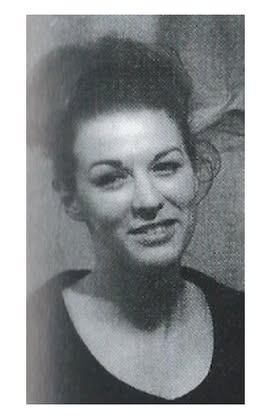
How about this woman?
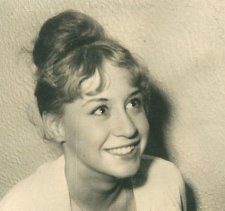
No? Well, one of them inspired Paul McCartney to write one of rock’s greatest tunes. The year was 1962. Things were starting to happen for Paul’s band, the Beatles. The lads had signed their first recording contract with EMI Records, and the group’s popularity was starting to grow beyond their hometown of Liverpool.
In the fall of that year, Paul got an idea for a tune as he was driving back from a concert in Southport. He soon had the basic melody worked out, claiming he stole the bass line from a Chuck Berry song called “Talkin’ About You.”
Then, according to one story, he took a day trip to London with the girl in the first photo, Celia Montgomery. Paul was 19. Celia was 17. She claims Paul worked out the lyrics while walking around London with her – Paul obviously trying to impress her by making the song about her.
The other story is that Paul was inspired by another 17-year-old he was dating that year – the girl in the second photo, Iris Caldwell. Iris was the younger sister of Liverpool music legend Rory Storm (whose real name was Alan Caldwell). According to that story, Paul worked out the song while visiting the Caldwell home.
No matter which version is true, Paul had a nearly complete version by October of 1962. He then played the song for his songwriting partner, John Lennon. The opening line was fine, “She was just seventeen,” but John actually broke out laughing at Paul’s original second line, “Never been a beauty queen.” They quickly changed it to “You know what I mean,” although neither of them knew exactly what that meant.
John said later that he contributed a random lyric here and there, but the song was basically Paul’s. However, they liked the song well enough that it immediately became the opening number at their live shows. It was also selected as the first track on their very first LP, Please Please Me.
That version was recorded in February of 1963 during a marathon recording session that saw the Fab Four lay down 10 of the album’s 14 tracks (including Lennon’s legendary one-take recording of “Twist and Shout”). Producer George Martin decided to keep in Paul’s countdown to the song – “1-2-3-4” – because he liked the energy it gave the track, and as the opening track, it would also be the perfect way for the group to kick off their very first album.
While the song was not released in the UK as a single back then, Capitol Records chose it as the B-side of the first Beatles single they would release in America, “I Want to Hold Your Hand.” While the A-side roared its way to #1, the B-side performed very respectfully, reaching #14 on the Billboard Hot 100. At that time, no artist was getting their B-sides any airplay, so it simply demonstrated how massive Beatlemania became in the first few weeks of 1964.
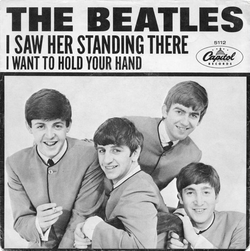
Over the years, “I Saw Her Standing There” has only grown in stature. It’s performed live far more often than “I Want to Hold Your Hand.”
John Lennon recorded his own version of the song, backed by Elton John’s band as part of one of Elton’s concerts. Both George Harrison and Ringo performed versions of the song live, making it the only Beatles song all four members performed during their respective solo careers. Other artists who have covered the song include Little Richard, Bruce Springsteen, the Tubes, the Who, and even teeny-bop singer Tiffany, whose version actually broke into the American Top 10 in 1988. On his most recent swing through the States, McCartney himself used “I Saw Her Standing There” as his opening number – sixty years after the Beatles used it as their opening number.
Sometimes, simplicity can be timeless!