


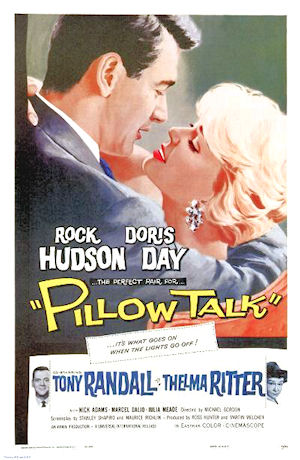
 If one comedy personified how Americans saw themselves in the early 1960’s, that comedy would be Pillow Talk. This first teaming of Doris Day and Rock Hudson was instant box office gold, racking up $18 million in ticket sales (back then, that was a blockbuster!) and leading to more on-screen teamings of the two.
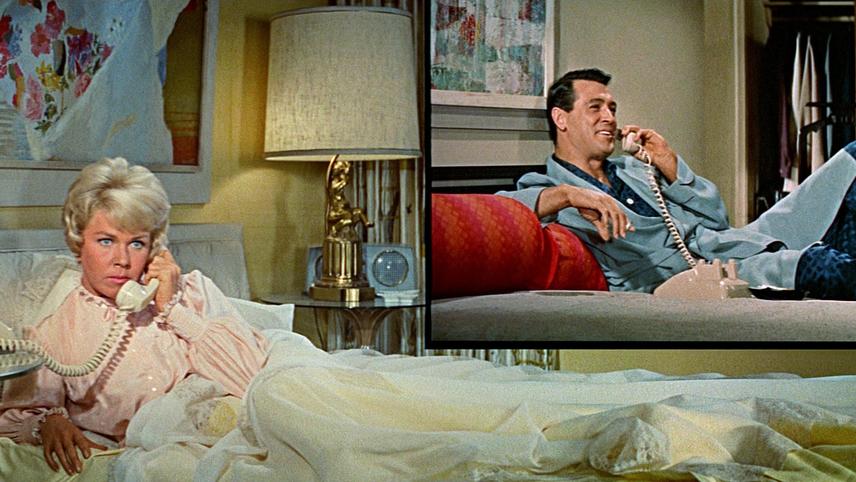
 Now, the entire premise of Pillow Talk makes it impossible to remake today. It revolves around something we once called a “party line.”
Most people would have trouble remembering a time without cell phones, let alone a time when even the most glamorous of people (like Hudson & Day’s characters in this comedy) had to share their telephone line with total strangers.
The gimmick is a clever twist on the mistaken identity meme quite common in farce.
High level interior decorator Jan Morrow (Day) and skirt-chasing Broadway composer Brad Allen (Hudson) share a party line in midtown Manhattan. His monopolizing of that line leads to verbal fireworks and an on-going feud.
Until they meet when, of course, they immediately fall in love. However, Hudson quickly realizes who Day really is and invents a phony persona, Texas tycoon Rex Stetson to woo the unsuspecting and always virginal Ms. Day.
Enter an irony that makes watching the film today even more of a hoot. Brad Allen via the party line keeps suggesting to Morrow that “Rex Stetson,” the lover boy he’s pretending to be, may be “a little light in the loafers” as people used to say.
 Knowing what we do now about Hudson’s private life, those scenes take on a surreal quality.
And scope out Hudson’s New York “apartment.” It’s a two-story number with a circular staircase between floors. Only slightly smaller than the Taj Mahal, one wonders where in Manhattan one could find such a showplace. And is it rent-controlled?
Anyway, the whole film is a delightful time capsule that shows us not as we really were, but as we wished we could have been.
Of course, the duo, along with sidekick Tony Randall, would be back in other comedies like Lover Come Back and Send Me No Flowers, with Doris somehow regaining her virginity. But this first entry is still the best, having earned an Oscar for Best Original Screenplay as well as nominations for Day and female co-star Thelma Ritter.
Pillow Talk is available on disc and streaming services online.